
 ENG
ENG
 English
 中文简体
中文简体 русский
 Español
 عربى
عربى
Exhaust manifold sealing sits at the far edge of what room temperature vulcanizing silicone can handle. A cast manifold flange on a fully loaded engine runs somewhere between 500 C and 650 C, and the turbine inlet of a turbocharged engine can pass 800 C. The continuous service ceiling of a typical high temp RTV silicone is 260 C to 315 C. The distance between those numbers explains why the same tube of sealant can hold a joint for years in one location and fail within a week in another.
Used with discipline, high temp RTV silicone is a practical workshop material for exhaust work. It dresses a new gasket on a flange with light surface pitting, seals a slip joint or ball flange downstream of the manifold, protects a heat shield fastener, and forms a fillet around a cooler connection. Used as a replacement for a manifold gasket, or as a repair for a crack or a rust perforation, it fails quickly and can take an oxygen sensor with it.
- 260 C to 315 C - continuous rating of most high temp RTV silicones
- 500 C to 650 C - manifold flange temperature under sustained load
- 24 hours - minimum full cure before the first heat cycle
The sections below cover what the material is, what its ratings mean in practice, where it belongs on an exhaust system, how to apply it so the joint survives thermal cycling, and which failure modes point to the joint rather than to the sealant.
Why Exhaust Manifolds Punish Sealants
Three physical conditions work against any soft sealant on a manifold joint, and all three act at the same time.
Extreme, repeated temperature swings
A manifold flange lives through the widest temperature range of any bolted joint on a vehicle apart from the exhaust valves themselves. From a cold start at ambient temperature to a hard pull on a long grade, the surface can move through several hundred degrees in a few minutes and then cool back down when the driver lifts off. Cured silicone rubber can follow that movement, but every excursion past its continuous rating costs a little elastic recovery, and the loss accumulates over thousands of cycles.
Differential expansion between dissimilar metals
An aluminium cylinder head expands at roughly twice the rate of a cast iron manifold across the same temperature change. At the flange face the two parts slide against each other, and whatever sits between them is loaded in shear. A soft film of sealant tolerates that movement. A thick, heavily filled bead does not, and it tears away from one face instead of stretching.
Vibration, bolt relaxation and surface scale
Manifold fasteners are short, hot and heavily loaded, and they lose preload as the joint cycles. Loose bolts let the flange breathe, which pumps hot gas into the seal line. On older engines, scale and pitting on the flange face reduce the contact area until the gasket alone can no longer bridge the gap. No sealant compensates for a joint that has stopped behaving like a joint.
| Operating condition | Typical surface temperature | What it means for RTV silicone |
|---|---|---|
| Idle, fully warm | 200 C to 300 C | Inside the range of high temp grades, above general purpose silicone |
| Steady cruise, light load | 350 C to 450 C | Above the continuous rating of every one part RTV silicone |
| Sustained load or towing | 550 C to 650 C | Only a metal gasket and correct bolt preload survive here |
| Turbocharger turbine inlet | 750 C to 900 C | RTV silicone has no role at this location |
What High Temp RTV Silicone Is and What Its Ratings Really Mean
The material in plain terms
A one part RTV silicone is a paste built on a silicone polymer, thickened with fillers and cured by moisture from the air. High temperature grades use heat stable fillers such as iron oxide, aluminium oxide or copper powder, together with a cure system chosen to suit the joint. Acetoxy systems release acetic acid and smell of vinegar, while oxime and alkoxy systems are neutral and produce far less corrosive vapour around metal and electrical components.
Cure proceeds from the surface inward at roughly 1 mm per 12 to 24 hours at 20 C. A thick bead stays soft in the middle far longer than its surface suggests, which matters because a manifold flange cannot be reopened to check progress.
Continuous, intermittent and peak ratings
Continuous rating describes the temperature the cured rubber can hold for hundreds of hours without measurable loss of elasticity. Intermittent or peak rating covers short excursions measured in minutes, after which the material is expected to recover as the joint cools. A product rated 315 C peak and 260 C continuous is a 260 C sealant in any practical sense, and manifold flanges under load sit well past the peak figure.
What happens above the limit
Above the continuous limit the polymer backbone begins to break down. The sealant first loses elasticity, then hardens and chalks, then cracks at the bond line. The process is slow rather than sudden, so the leak usually appears on a cold morning months after the repair looked successful.
| Silicone type | Continuous limit | Short peak limit | Sensible exhaust applications |
|---|---|---|---|
| General purpose silicone | 200 C | 230 C | Coolant housings, covers, low temperature accessory joints |
| High temp RTV, non copper | 260 C | 300 C | Gasket dressing on cooler flanges, bracket and shield fasteners |
| Copper filled high temp RTV | 315 C | 370 C | Manifold gasket dressing, slip joints, sensor safe flange sealing |
| Two part addition cure industrial | 250 C to 300 C | 350 C | Formed in place gaskets in production, not field repair |
Where High Temp RTV Silicone Belongs on an Exhaust System
Joints where it is a good fit
- Dressing a new metal or composite exhaust gasket on a flange with light pitting or minor scale, applied as a film no thicker than 1 mm on both faces
- Sealing slip joints, ball and socket flanges, and clamp connections downstream of the manifold where gas temperature has dropped below roughly 300 C
- Sealing the threads of exhaust gas temperature probes and pressure fittings mounted on the cooler side of the system
- Locking and sealing heat shield fasteners that see radiant heat rather than direct gas flow
- Sealing turbo oil drain flanges, charge pipe joints and other connections that stay below 200 C
- Building a temporary fillet over a patch on a low pressure downstream pipe, with the understanding that this is a short term measure rather than a repair
Joints where it will not work
- As the only seal between the cylinder head and the manifold flange. No thickness of RTV silicone can replace a steel or multi layer gasket at 600 C
- Anywhere upstream of the turbocharger, including the turbine inlet and the manifold to turbo flange
- Cracks in a cast iron manifold or a cracked weld. Cast iron cracks propagate under thermal cycling and require welding or replacement
- Rust perforations in a pipe wall. Silicone cannot bridge a hole carrying hot, pulsating gas
- Joints where flange flatness is out of specification. A workable field limit is about 0.1 mm of deviation across the sealing face and no visible gap under a 0.05 mm feeler gauge
The practical rule is simple: sealant supports a gasket, it does not replace one. If a gasket is missing or the flange has warped, replace the hardware first and use sealant only as an assembly aid.
How to Apply High Temp RTV Silicone to an Exhaust Joint
- Check that the joint qualifies. Measure flange flatness and the gap with a feeler gauge before buying sealant. If a gasket is missing or a flange is warped, stop and replace hardware.
- Disassemble and clean. Scrape old gasket material with a plastic or brass scraper. A wire brush is acceptable on cast iron, but avoid grinding the sealing face.
- Degrease both faces. Wipe with a solvent that leaves no residue and let it flash off for 5 to 10 minutes. Silicone will not bond to an oil film, and exhaust flanges are almost always oily.
- Dry fit and check threads. Confirm that bolts spin freely, chase the threads if needed, and check that the joint closes without force.
- Apply the sealant. For a gasket dressing, spread a 0.5 mm to 1 mm film on both sides of the gasket and keep the film clear of the port opening. For a formed in place bead, run a continuous 3 mm to 5 mm bead around the bolt holes and along the flange with no breaks.
- Assemble within the working time. Most high temp RTV silicones allow 10 to 20 minutes of open time. Once the faces touch, the material starts to set.
- Torque in stages. Snug the fasteners by hand, then torque in a cross pattern from the centre outward in two or three stages to specification.
- Cure before heat. Leave the joint for at least 24 hours at 20 C or above before starting the engine. Heat applied to uncured sealant skins the surface and traps moisture inside.
- Run a heat cycle and re-torque. Bring the engine to operating temperature, let it cool completely, then re-torque to specification. Some preload loss on the first cycle is normal.
| Sealant thickness | Minimum cure at 20 C | Notes |
|---|---|---|
| 0.5 mm to 1 mm film | 12 to 24 hours | Gasket dressing on a flange face |
| 3 mm bead | 24 hours | Flange bead used together with a gasket |
| 5 mm bead | 36 to 48 hours | Deep fillets, soft core if disturbed early |
| Any thickness, heated within 1 hour | Not recommended | Surface skins over, core stays uncured |
How to Choose the Right High Temp RTV Silicone
Selection comes down to a short list of specifications that can be checked against a technical data sheet before purchase.
- A continuous rating of 260 C or more, with an intermittent rating of at least 315 C
- A neutral cure system, described as sensor safe or low volatility, to limit corrosive vapour and silicone migration
- Resistance to engine oil, coolant and fuel, since flange faces are rarely clean
- A non sag paste consistency that stays where it is placed on a vertical or overhead surface
- Adhesion to lightly oily metal without a primer, which shortens field preparation time
- A working time of 10 to 20 minutes and full cure within 24 hours at room temperature
- A colour that contrasts with the metal, so squeeze out and later leakage are easy to spot
For exhaust work specifically, a copper filled grade is the usual first choice because the filler improves heat transfer through the seal and raises the short peak ceiling. Where several grades look equivalent on paper, a structured industrial RTV silicone sealant selection guide is a faster route to a shortlist than reading data sheets alone.
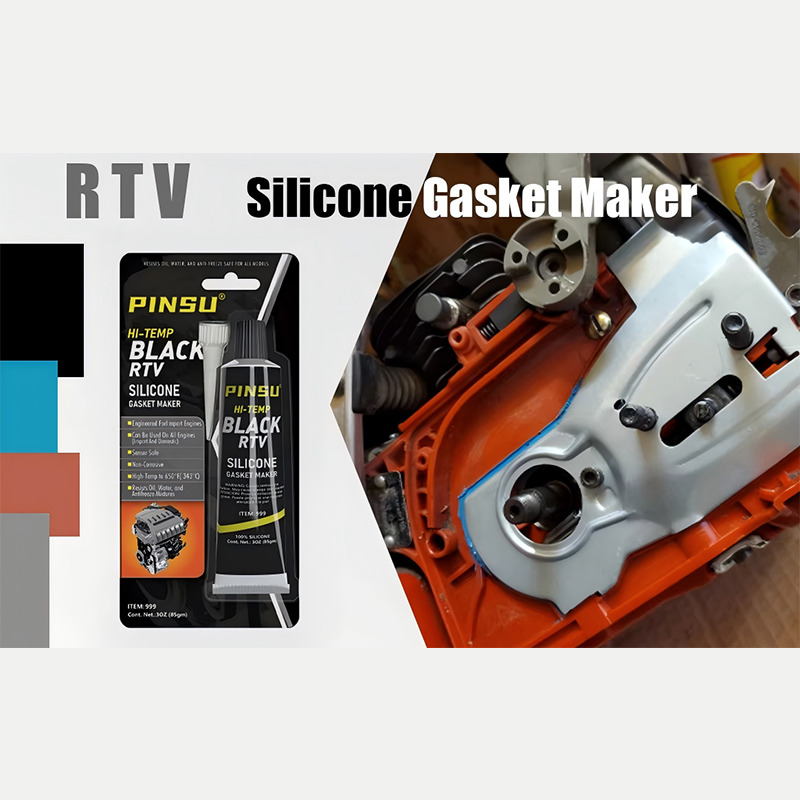 PINSU - Red/Black/Grey RTV High Temperature Resistant Silicone Gasket Seal - Automotive/InPINSU-RTV Silicone Gasket is a high-performance, one-component, room temperature vulcanized silicone rubber sealant. It provides reliable sealing performance in mechan...View Product →
Whatever grade is chosen, buy enough for one complete application plus a spare tube. Reopening a joint to add more sealant after assembly is a guaranteed way to introduce a leak path.
Common Failure Modes and What They Tell You
When a repair fails, the appearance of the sealant usually identifies the cause before any pressure test is run.
| Symptom | Likely cause | Corrective action |
|---|---|---|
| Sealant still tacky after 24 hours | Low humidity, thick bead, oily surface | Clean again, use a thinner film, extend the cure period |
| Bubbles or blisters in the bead | Engine started before full cure | Remove, reclean and cure fully before the first start |
| Hard, brittle, cracked rubber | Continuous temperature limit exceeded | Rely on a gasket at that location, or accept a cooler joint |
| Leak returns within weeks | Flange warp, lost bolt preload, gasket compression set | Check flatness and torque, replace the gasket |
| Soot streaks beside the seal | Faces not parallel, damaged gasket | Resurface or replace the flange |
| Sensor fault after the repair | Non sensor safe formula, excess squeeze out | Use a neutral cure product and keep squeeze out out of the gas path |
Sensor, Emission and Fire Safety Considerations
Cured silicone rubber is chemically stable, but uncured material releases volatile compounds while it sets. Some of those compounds can deposit on a heated oxygen sensor element or on catalyst surfaces, and the effect is cumulative rather than immediate. A repair that pushes a large amount of uncured sealant into the exhaust stream can shorten sensor life without any obvious connection at the time.
Three habits reduce the risk. Keep the sealant film thin and inside the joint line. Choose a neutral cure, sensor safe product whenever the joint sits downstream of an oxygen sensor. Wipe away squeeze out before the first start rather than letting it burn off on the pipe.
Fire safety also matters. Uncured sealant on an external hot surface will smoke heavily and can ignite residue on a dirty manifold. Work on a cold engine, remove excess material, and ventilate the workspace while the sealant sets.
Inspection and Re-Torque After the Repair
- First check after the initial heat cycle: re-torque all fasteners cold and look for fresh soot trails at the flange edge
- Second check after roughly 500 km or two weeks of use: confirm the seal is intact and that no fastener has backed off
- Then inspect at every service interval, focusing on the flange edge rather than the pipe surface
- Record any exhaust gas temperature readings if the vehicle is equipped with a probe, since a slow rise at a fixed load often precedes a small leak
- Expect a properly dressed flange gasket downstream of the manifold to last several years, while a dressed manifold flange with a gasket present typically holds for months before the gasket itself needs replacement
Frequently Asked Questions
Q1: Can high temp RTV silicone replace an exhaust manifold gasket?
No. Even the highest rated one part silicone is limited to roughly 315 C continuous, while a loaded manifold flange runs between 500 C and 650 C. Sealant can dress a gasket, but it cannot serve as the only sealing layer on a manifold to head joint.
Q2: What temperature can high temp RTV silicone actually withstand?
Typical high temperature grades hold 260 C continuously with short peaks near 300 C, and copper filled versions reach about 315 C continuous with peaks around 370 C. These figures apply to thin films; thick beads age faster because heat builds up inside them.
Q3: How long should the engine stay off after applying the sealant?
Allow at least 24 hours at 20 C or above before the first start. A thin film may reach full cure in 12 hours in warm, humid conditions, but starting the engine early skins the surface and traps moisture inside the bead.
Q4: Is high temp RTV silicone safe for oxygen sensors?
Only neutral cure products labelled sensor safe should be used near a sensor. Acetoxy sealants release acetic acid vapour, and any uncured silicone that enters the exhaust stream can deposit on the sensor element or the catalyst. Keeping the film thin and inside the joint reduces the risk further.
Q5: How thick should the sealant bead be on an exhaust flange?
For a gasket dressing, a film of 0.5 mm to 1 mm on each face is enough. For a formed in place bead alongside a gasket, a continuous 3 mm to 5 mm bead is the usual range. Thicker beads cure slowly and are more likely to blister.
Q6: Why did my high temp sealant turn hard and brittle?
The joint almost certainly exceeded the continuous temperature rating of the product. Repeated excursions past the limit break down the polymer, remove elasticity, and eventually crack the bond line. Moving to a cooler location or restoring the original gasket is the only durable answer.
Q7: Can RTV silicone repair a cracked exhaust manifold?
No. Cast iron cracks propagate under thermal cycling and must be welded or the manifold replaced. Sealant placed over a crack may hold for a few heat cycles, then fails and can mask a worsening leak.
High temp RTV silicone for exhaust manifold work is a supporting material, not a structural one. It performs well as a gasket dressing, as a seal on cooler downstream joints, and as a protective fillet around fittings that never see full manifold temperature. It performs badly whenever it is asked to bridge a missing gasket, a warped flange or a crack.
The working method that produces reliable results is short and repeatable: confirm the joint is sound, clean and degrease both faces, apply a thin film or a 3 mm to 5 mm bead, torque in stages, cure for 24 hours before heat, then re-torque cold after the first cycle. Match those steps with a product rated at 260 C continuous or better, and the repair will behave predictably instead of becoming a repeat visit.

 TOP
TOP